
MCP Accessibility Scanner 🔍
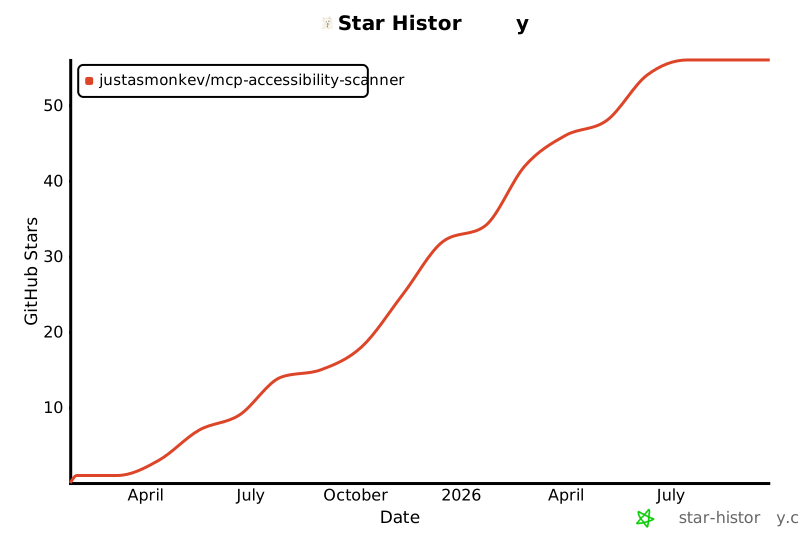
Star History

A powerful Model Context Protocol (MCP) server that provides automated web accessibility scanning and browser automation using Playwright and Axe-core. This server enables LLMs to perform WCAG compliance checks, interact with web pages, manage persistent browser sessions, and generate detailed accessibility reports with visual annotations.
Features
Accessibility Scanning
✅ Full WCAG 2.0/2.1/2.2 compliance checking (A, AA, AAA levels) 📄 Detailed JSON reports with remediation guidance 🎯 Support for specific violation categories (color contrast, ARIA, forms, keyboard navigation, etc.)
Browser Automation
🖱️ Click, hover, and drag elements using accessibility snapshots ⌨️ Type text and handle keyboard inputs 🔍 Capture page snapshots to discover all interactive elements 📸 Take screenshots and save PDFs 🎯 Support for both element-based and coordinate-based interactions
Advanced Features
📑 Tab management for multi-page workflows 🌐 Monitor console messages and network requests ⏱️ Wait for dynamic content to load 📁 Handle file uploads and browser dialogs 🔄 Navigate through browser history
Installation
You can install the package using any of these methods:
Using npm: ``bash npm install -g mcp-accessibility-scanner ``
Installation with Docker
A pre-built image is available on Docker Hub. The image includes Chromium and is pre-configured for containerized use — no extra flags needed.
Pull from Docker Hub: ``bash docker pull justasmonkev/mcp-accessibility-scanner ``
Claude Code
claude mcp add mcp-accessibility-scanner -s user -- docker run -i --rm justasmonkev/mcp-accessibility-scannerTo persist screenshots and reports on your host, add a volume mount:
claude mcp add mcp-accessibility-scanner -s user \
  -- docker run -i --rm -v /tmp/mcp-output:/app/output justasmonkev/mcp-accessibility-scanner
Without the -v mount, output files only exist inside the container and are lost when it exits.
Docker Compose
docker compose up -dBuild from source
docker build -t mcp-accessibility-scanner .Docker smoke test
npm run test:dockerInstallation in VS Code
Install the Accessibility Scanner in VS Code using the VS Code CLI:
For VS Code: ``bash code --add-mcp '{"name":"accessibility-scanner","command":"npx","args":["mcp-accessibility-scanner"]}' ``
For VS Code Insiders: ``bash code-insiders --add-mcp '{"name":"accessibility-scanner","command":"npx","args":["mcp-accessibility-scanner"]}' ``
CLI Modes
The scanner can run in two modes depending on how you use it.
MCP server (default, no subcommand)
When launched without a subcommand, the process starts an MCP server that communicates over stdio. This is the mode used by MCP clients such as Claude Desktop, VS Code, and Claude Code -- you should never need to run it by hand.
npx mcp-accessibility-scanner # starts the MCP server (stdio)All of the MCP client configuration examples in this README already use this default mode.
Interactive REPL (interactive subcommand)
For manual terminal use, the interactive subcommand starts a readline REPL where you can call any tool directly:
$ npx mcp-accessibility-scanner interactive
Interactive mode. Type "<tool-name> <json>" to call a tool. Ctrl+D to exit.
> browser_navigate {"url": "https://example.com"}
> scan_page {"violationsTag": ["wcag21aa"]}
> audit_keyboard {"maxTabs": 30}
Each line is <tool-name> <json-arguments>. Omit the JSON to pass {}. Global browser connection flags still apply here, for example npx mcp-accessibility-scanner --headless interactive.
Discovering available tools (list-tools subcommand)
To print every tool name and its description:
npx mcp-accessibility-scanner list-toolsNote: Tool names like
browser_navigateandscan_pageare MCP tool identifiers (and REPL commands in interactive mode). They are not shell subcommands -- you cannot runnpx mcp-accessibility-scanner browser_navigate.
Configuration
Here's the Claude Desktop configuration:
{
  "mcpServers": {
    "accessibility-scanner": {
      "command": "npx",
      "args": ["-y", "mcp-accessibility-scanner"]
    }
  }
}
Advanced Configuration
You can pass a configuration file to customize Playwright behavior:
{
  "mcpServers": {
    "accessibility-scanner": {
      "command": "npx",
      "args": ["-y", "mcp-accessibility-scanner", "--config", "/path/to/config.json"]
    }
  }
}
Configuration Options
Create a config.json file with the following options:
{
  "browser": {
    "browserName": "chromium",
    "launchOptions": {
      "headless": true,
      "channel": "chrome"
    },
    "cdpLaunch": {
      "command": "open",
      "args": ["-a", "Slack", "--args", "--remote-debugging-port={port}"],
      "startupTimeoutMs": 30000
    }
  },
  "timeouts": {
    "navigationTimeout": 60000,
    "defaultTimeout": 5000
  },
  "network": {
    "allowedOrigins": ["example.com", "trusted-site.com"],
    "blockedOrigins": ["ads.example.com"]
  }
}
Available Options:
browser.browserName: Browser to use (chromium,firefox,webkit)browser.launchOptions.headless: Run browser in headless mode (default:trueon Linux without display,falseotherwise)browser.launchOptions.channel: Browser channel (chrome,chrome-beta,msedge, etc.)browser.cdpEndpoint: Attach to an already-running Chromium-family app with CDP enabledbrowser.cdpLaunch: Launch a Chromium-family desktop app with CDP enabled, wait for the endpoint, and manage the child process lifecycletimeouts.navigationTimeout: Maximum time for page navigation in milliseconds (default:60000)timeouts.defaultTimeout: Default timeout for Playwright operations in milliseconds (default:5000)network.allowedOrigins: List of origins to allow (blocks all others if specified)network.blockedOrigins: List of origins to block
CLI equivalents are also available: --cdp-launch-command, --cdp-launch-args, --cdp-launch-cwd, --cdp-launch-port, and --cdp-launch-startup-timeout.
HTTP Heartbeat
When the server runs with --port, it sends MCP heartbeat pings for Streamable HTTP sessions. Set PLAYWRIGHT_MCP_PING_TIMEOUT_MS to override the default 5000 ms timeout. Set it to 0 or any negative value to disable heartbeat pings for clients or proxies that do not answer server-initiated pings.
Available Tools
The MCP server provides comprehensive browser automation and accessibility scanning tools:
Core Accessibility Tool
scan_page
Performs a comprehensive accessibility scan on the current page using Axe-core.
Parameters:
violationsTag: Array of WCAG/violation tags to check
Supported Violation Tags:
- WCAG standards:
wcag2a,wcag2aa,wcag2aaa,wcag21a,wcag21aa,wcag21aaa,wcag22a,wcag22aa,wcag22aaa - Section 508:
section508 - Categories:
cat.aria,cat.color,cat.forms,cat.keyboard,cat.language,cat.name-role-value,cat.parsing,cat.semantics,cat.sensory-and-visual-cues,cat.structure,cat.tables,cat.text-alternatives,cat.time-and-media
Audit Tools
audit_site
Crawls and scans multiple internal pages, then aggregates violations across the site.
- Default strategy: link-based BFS from the current URL
- Supports
links,nav,sitemap, andprovidedURL strategies - Always writes a JSON report (default filename:
audit-site-{timestamp}.json)
Example flow: ```text
- Navigate to your site homepage with browser_navigate
- Run audit_site with maxPages: 25 and maxDepth: 2
- Review the report path returned by the tool (written to the MCP output directory)
#### `scan_page_matrix`
Runs Axe scans on the same page across viewport/media/zoom variants and compares deltas against baseline.
- Default variants: baseline, mobile, desktop, forced-colors, reduced-motion, zoom-200
- Supports custom variants and optional reload between variants
- Always writes a JSON report (default filename: `scan-matrix-{timestamp}.json`)

**Example flow:**- Navigate to a page state you want to validate
- Run scan_page_matrix with defaults (or provide custom variants)
- Review per-variant deltas and open the generated JSON report path
#### `audit_keyboard`
Audits real keyboard focus behavior by pressing Tab (and optional Shift+Tab) with practical heuristics.
- Checks skip links, focus visibility, focus jumps, and possible focus traps
- Optional issue screenshots (`screenshotOnIssue`)
- Always writes a JSON report (default filename: `audit-keyboard-{timestamp}.json`)

**Example flow:**- Navigate to the target page and let it fully load
- Run audit_keyboard with maxTabs: 50
- Review focus findings and open the generated JSON report path
### Navigation Tools

#### `browser_navigate`
Navigate to a URL.
- Parameters: `url` (string)

#### `browser_navigate_back`
Go back to the previous page.

#### `browser_navigation_timeout`
Set default navigation timeout for existing tabs.
- Parameters: `timeout` (in ms; 30000-300000)

#### `browser_default_timeout`
Set default operation timeout for existing tabs.
- Parameters: `timeout` (in ms; 30000-300000)

### Page Interaction Tools

#### `browser_snapshot`
Capture accessibility snapshot of the current page (better than screenshot for analysis).

#### `browser_click`
Perform click on a web page element.
- Parameters: `element` (description), `ref` (element reference), `doubleClick` (optional)

#### `browser_type`
Type text into editable element.
- Parameters: `element`, `ref`, `text`, `submit` (optional), `slowly` (optional)

#### `browser_hover`
Hover over element on page.
- Parameters: `element`, `ref`

#### `browser_drag`
Perform drag and drop between two elements.
- Parameters: `startElement`, `startRef`, `endElement`, `endRef`

#### `browser_select_option`
Select an option in a dropdown.
- Parameters: `element`, `ref`, `values` (array)

#### `browser_fill_form`
Fill multiple fields with one call.
- Parameters: `fields` (array of objects with `name`, `type`, `ref`, and `value`)

#### `browser_press_key`
Press a key on the keyboard.
- Parameters: `key` (e.g., 'ArrowLeft' or 'a')

#### `browser_evaluate`
Evaluate a JavaScript expression on the page, or on a specific element when a `ref` is provided. The function's return value is serialized back as the result.
- Parameters: `function` (e.g., `() => document.title` or `(element) => element.textContent`), `element` (optional), `ref` (optional)

### Screenshot & Visual Tools

#### `browser_take_screenshot`
Take a screenshot of the current page.
- Parameters: `filename` (optional), `type` (`png` or `jpeg`), `fullPage` (optional), `element`/`ref` pair (for element screenshots)

#### `browser_pdf_save`
Save page as PDF.
- Parameters: `filename` (optional, defaults to `page-{timestamp}.pdf`)

This tool requires `--caps pdf` in the CLI.

#### `browser_install`
Install the configured browser engine (use when browser executable is missing).
- Parameters: none

### Browser Management

#### `browser_close`
Close the page.

#### `browser_resize`
Resize the browser window.
- Parameters: `width`, `height`

### Tab Management

#### `browser_tabs`
Manage browser tabs in one tool.
- Parameters: `action` (`list`, `new`, `close`, `select`) and optional `index` (for `close` and `select`).

### Information & Monitoring Tools

#### `browser_console_messages`
Returns all console messages from the page.

#### `browser_network_requests`
Returns all network requests since loading the page.

### Utility Tools

#### `browser_wait_for`
Wait for text to appear/disappear or time to pass.
- Parameters: `time` (optional), `text` (optional), `textGone` (optional)

#### `browser_handle_dialog`
Handle browser dialogs (alerts, confirms, prompts).
- Parameters: `accept` (boolean), `promptText` (optional)

#### `browser_file_upload`
Upload files to the page.
- Parameters: `paths` (array of absolute file paths)

#### `browser_verify_element_visible`
Verify an element by ARIA role/name.
- Parameters: `role`, `accessibleName`

#### `browser_verify_text_visible`
Verify text visibility.
- Parameters: `text`

#### `browser_verify_list_visible`
Verify list items at a snapshot reference.
- Parameters: `element`, `ref`, `items` (array)

#### `browser_verify_value`
Verify an element value or checked state.
- Parameters: `type`, `element`, `ref`, `value`

These verification tools require `--caps verify`:

### Vision Mode Tools (Coordinate-based Interaction)

These tools require `--caps vision`:

#### `browser_mouse_move_xy`
Move mouse to specific coordinates.
- Parameters: `element`, `x`, `y`

#### `browser_mouse_click_xy`
Click at specific coordinates.
- Parameters: `element`, `x`, `y`

#### `browser_mouse_drag_xy`
Drag from one coordinate to another.
- Parameters: `element`, `startX`, `startY`, `endX`, `endY`

#### Note
Coordinate-based tools require `element` descriptions for permission checks, but the coordinates themselves are used for action targeting.

## Usage Examples

### Basic Accessibility Scan- Navigate to example.com using browser_navigate
- Run scan_page with violationsTag: ["wcag21aa"]
### Color Contrast Check- Use browser_navigate to go to example.com
- Run scan_page with violationsTag: ["cat.color"]
### Multi-step Workflow- Navigate to example.com with browser_navigate
- Take a browser_snapshot to see available elements
- Click the "Sign In" button using browser_click
- Type "user@example.com" using browser_type
- Run scan_page on the login page
- Take a browser_take_screenshot to capture the final state
### Page Analysis- Navigate to example.com
- Use browser_snapshot to capture all interactive elements
- Review console messages with browser_console_messages
- Check network activity with browser_network_requests
### Tab Management- Open a new tab with
browser_tabsand{"action":"new"} - Navigate to different pages in each tab
- Switch to a tab with
browser_tabsand{"action":"select", "index": 1} - List all tabs with
browser_tabsand{"action":"list"}
### Waiting for Dynamic Content- Navigate to a page
- Use browser_wait_for to wait for specific text to appear
- Interact with the dynamically loaded content
**Note:** Most interaction tools require element references from browser_snapshot. Always capture a snapshot before attempting to interact with page elements.

## Development

Clone and set up the project:
git clone https://github.com/JustasMonkev/mcp-accessibility-scanner.git cd mcp-accessibility-scanner npm install ```
License
MIT


